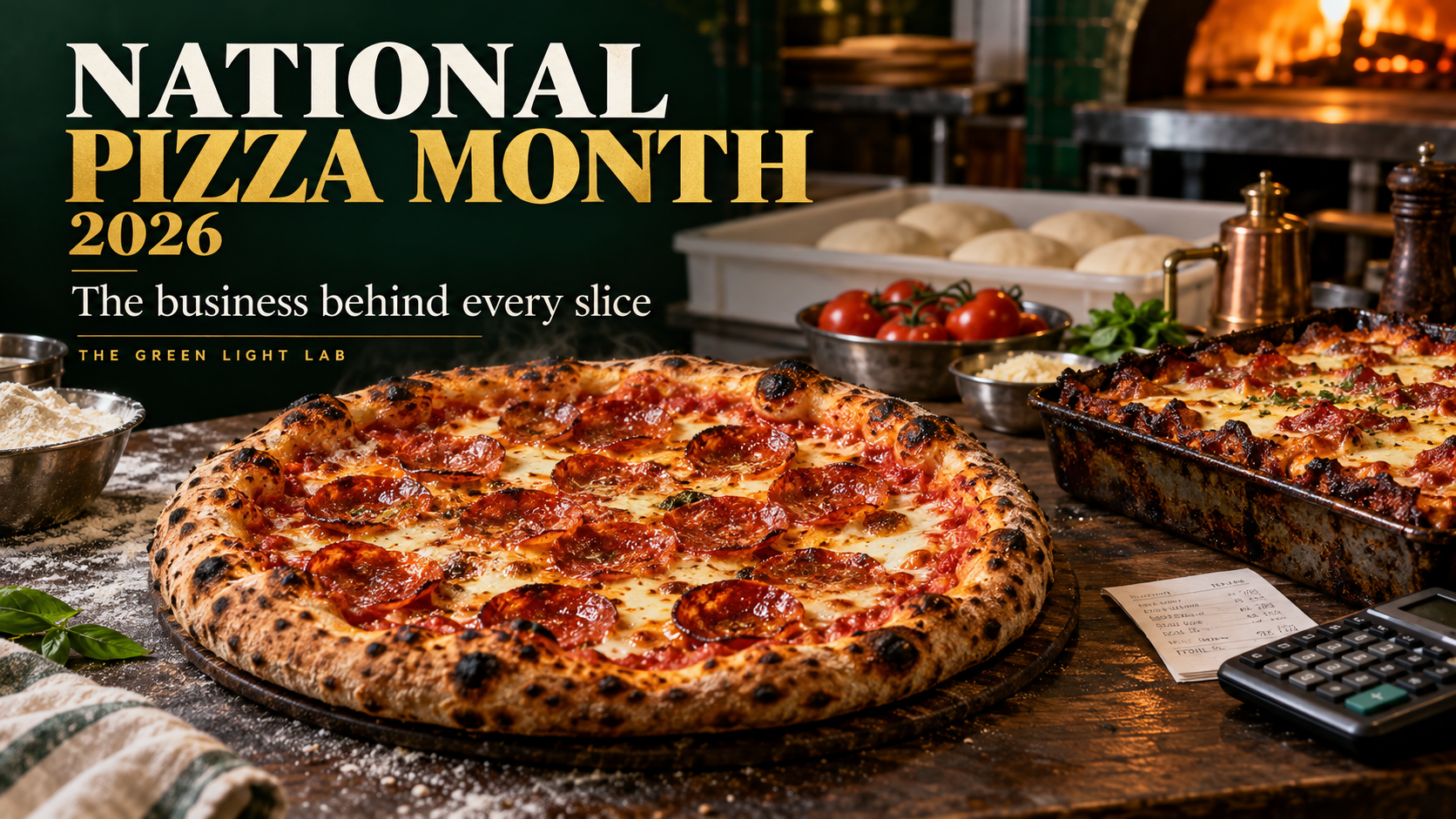
October is National Pizza Month.
And if you spend any amount of time around the pizza industry right now, you already know it.
My social feeds are full of pizza promotions. Restaurants are launching specials. Chains are pushing value. Independent shops are creating limited-time pizzas, contests, giveaways and community events.
Everyone wants a piece of October.
But underneath all those promotions is a much more interesting story.
National Pizza Month offers a good look at one of the biggest challenges in the pizza business today:
How does a small independent operator compete against companies that can sell pizza at prices you simply cannot match?
I am looking at that question from three different perspectives.
I am a food scientist.
I am a chef.
And now, as I prepare Underground Pizza Truck for operation, I am also the guy who has to decide what a pizza actually needs to cost.
Those three perspectives do not always arrive at the same answer.
Pizza Month Has Been Around Since 1984
National Pizza Month traces its roots to 1984, when pizzeria operator Gerry Durnell created the observance while launching Pizza Today magazine. Pizza Today says Congress later formally recognized October as National Pizza Month in 1987.
1984 happens to mean something else to me.
I grew up in Detroit.
And in 1984, the Detroit Tigers won the World Series.
They finished the regular season 104-58 and beat the San Diego Padres four games to one in the World Series.
So apparently 1984 was a pretty good year for both baseball and pizza.
There is another connection that makes the story even better.
Detroit-style pizza is not simply a piece of Michigan nostalgia anymore.
Pizza Today's 2026 industry report ranks Detroit style fourth among the most prevalent pizza styles in the United States and, more importantly, identifies it as the No. 1 trending pizza style operators are watching.
Even Domino's entered the category this year, launching a Detroit-style personal pizza nationally on August 31.
A style that Detroiters simply grew up calling pizza has become part of the national conversation.
That tells you something important about this business.
Pizza constantly changes while somehow staying familiar.
National Pizza Month Has Become a Marketing Laboratory
Look at what operators are doing for National Pizza Month in 2026 and you quickly realize there is no single strategy.
Wiseguy Pizza is discounting whole 18-inch pizzas by 25 percent during October.
Sal's Pizza is using its anniversary to offer $9.99 cheese pizzas during a promotional week while combining the celebration with teacher discounts and its children's literacy program.
Riko's Pizza is using giveaways, including the chance to win a pizza every week for a year.
UNA Pizza + Wine is taking a different route entirely. Instead of building its entire campaign around price, it is creating content, pizza reheating information and even an online game designed to increase engagement and collect customer relationships.
These are very different ways of answering the same question:
How do I give somebody a reason to choose my pizza?
And that question becomes especially important for independent operators.
The $15 Pizza Problem
Let me use my own business as an example.
At Underground Pizza Truck, my working price for a 12-inch cheese pizza or pepperoni pizza is $15.
Could I sell it cheaper?
Probably.
Would that automatically make it a better business?
Absolutely not.
My pizza starts with handmade dough that receives a 72-hour fermentation.
I am using premium sauce.
Premium cheeses.
The best toppings I can reasonably source.
Then there are the things the customer never sees.
The commissary.
Insurance.
Licensing.
Propane.
Fuel.
Equipment.
Maintenance.
Packaging.
Credit-card processing.
Point-of-sale fees.
Labor.
Waste.
Cleaning.
Utilities.
Marketing.
And everything else required to operate a legitimate food business.
The ingredient cost is only the beginning.
Pizza Today made this same point while documenting the economics of launching a mobile pizzeria. Its example showed that even after calculating dough, sauce and cheese, the operator still had to account for packaging, commissary costs, labor, equipment and insurance before knowing what the pizza truly cost the business.
A $15 pizza is not $15 of profit.
Not even close.
So How Do I Compete With Domino's or Little Caesars?
I don't try to beat them at their game.
That would be a terrible business strategy.
Domino's is currently advertising a national mix-and-match promotion with qualifying items starting at $6.99 each and a carryout offer starting at $7.99, although pricing and participation vary by location.
I cannot build my business around trying to make a handcrafted pizza with premium ingredients and a 72-hour fermented dough for the same price a national company can promote through thousands of locations.
And frankly, I should not try.
My job is to make the comparison close enough that the customer can look at the two experiences and understand why mine costs more.
If a customer sees a national-chain pizza at $8 and mine at $15, I need to earn that additional seven dollars.
The dough has to matter.
The cheese has to matter.
The sauce has to matter.
The bake has to matter.
The service has to matter.
The experience has to matter.
The story has to matter.
That does not mean independents get permission to charge anything they want because something is "artisan."
Customers still know what pizza costs.
Value matters.
My goal is therefore not simply premium pricing.
It is defensible pricing.
The customer should be able to eat the pizza and understand where the money went.
Independents Are Not a Small Part of the Pizza Business
It is easy to assume the pizza industry belongs almost entirely to a few giant brands.
It doesn't.
Pizza Today's 2026 industry report estimates that independent pizzerias represent roughly 45 to 60 percent of the overall pizzeria market, depending on how the market is measured. More than 83 percent of respondents to its operator survey were independent operators.
That means thousands of operators are wrestling with the same question I am:
How much value can you deliver while still charging enough money to stay in business?
The big chains have enormous advantages.
Purchasing power.
Advertising reach.
Technology.
Distribution.
Established brand recognition.
National loyalty programs.
Huge amounts of consumer data.
But independents have advantages too.
We can move quickly.
We can know our customers personally.
We can change a pizza without sending the idea through six departments.
We can tell the story behind an ingredient.
We can build relationships with our communities.
We can create food that reflects the person making it.
Recent Pizza Today reporting on independent restaurants points specifically to agility, creativity and authenticity as important competitive strengths for independent operators in a difficult cost environment.
That is the battlefield where a small shop can win.
Not cheapest.
Different.
The Danger of Discounting Your Way Through October
This is where National Pizza Month gets interesting.
Discounts work.
There is a reason companies use them.
They generate traffic.
They create urgency.
They give somebody a reason to place an order tonight instead of next week.
But discounting also has consequences.
If your normal pizza is $15 and every promotion trains the customer to wait until you sell it for $10, you may have created traffic without creating a sustainable customer.
The better National Pizza Month campaigns seem to combine value with something else.
A limited pizza.
An event.
A contest.
A cause.
A community partnership.
A customer experience.
A loyalty incentive.
Content.
Education.
Something that gives customers a reason to engage with the restaurant without requiring the operator to sacrifice margin every time.
Pizza Today's 2026 trends report actually encourages operators to think beyond discounting and use specials and Pizza of the Week or Pizza of the Month concepts to create interest while keeping ingredient and preparation costs under control.
That is a much healthier conversation for independents.
Why Pizza Expo Matters
This month also gives the pizza industry another reason to gather.
On October 11 and 12, I will be attending Pizza Expo Columbus at the Greater Columbus Convention Center.
There is an important distinction here.
The International Pizza Expo in Las Vegas is the flagship event. Its organizers describe it as the world's largest pizza show, bringing together thousands of pizza professionals, suppliers, educators and competitors.
Pizza Expo Columbus is the Midwest edition produced by the same organization behind International Pizza Expo and Pizza Today.
The 2026 Columbus event is advertising more than 180 industry suppliers, 33 hours of education and 21 expert speakers across two days. It also includes demonstrations, networking and the Great American Pizza Challenge.
And it is not a consumer pizza festival.
It is a business-to-business trade show attended by pizzeria owners, managers, buyers, distributors, brokers and industry decision-makers.
That matters.
Because when hundreds of independent pizza people gather in one building, they are not simply talking about recipes.
They are talking about ovens.
Flour.
Cheese.
Labor.
Technology.
Food cost.
Marketing.
Insurance.
Efficiency.
Delivery.
Margins.
And how to stay in business.
In other words, the things customers rarely see when they look at the price printed beside a pizza.
National Pizza Month Is Really About the People Selling Pizza
National Pizza Month naturally celebrates the food.
But after more than 40 years, I think it also celebrates an industry.
There are giant corporations in this business.
There are regional chains.
There are family restaurants that have been operating for generations.
And there are people like me preparing to open a pizza truck and trying to figure out how to turn flour, tomatoes, cheese and a lot of work into a sustainable business.
All of us sell pizza.
But we do not all sell the same thing.
A national chain can sell convenience, familiarity and enormous purchasing power.
An independent can sell personality, craftsmanship, community and an experience that cannot be perfectly duplicated somewhere else.
The mistake would be assuming one has to become the other.
I do not need Underground Pizza Truck to become Domino's.
I need it to be worth $15.
And ultimately the customer gets to decide whether I succeeded.
That is the part of the pizza business I find fascinating.
National Pizza Month may put pizza in the spotlight for 31 days.
For the people who make their living from it, those questions continue every day of the year.
What's Next
I'll be at Pizza Expo Columbus October 11-12 looking at ingredients, equipment, technology, trends and the conversations operators are having about the future of the business.
After the show, I'll come back to Green Light Lab with a second article:
What I Actually Saw at Pizza Expo Columbus 2026: The Trends That Matter and the Ones That Don't.
No press-release recap.
I'll tell you what caught my attention as a food scientist, chef and independent operator preparing to put his own pizzas in front of customers.
Ray Sierengowski
Food Scientist | Chef | Author
Owner, Underground Pizza Truck
Fire In The Kitchen, LLC
© 2026 Fire In The Kitchen, LLC. All rights reserved.