
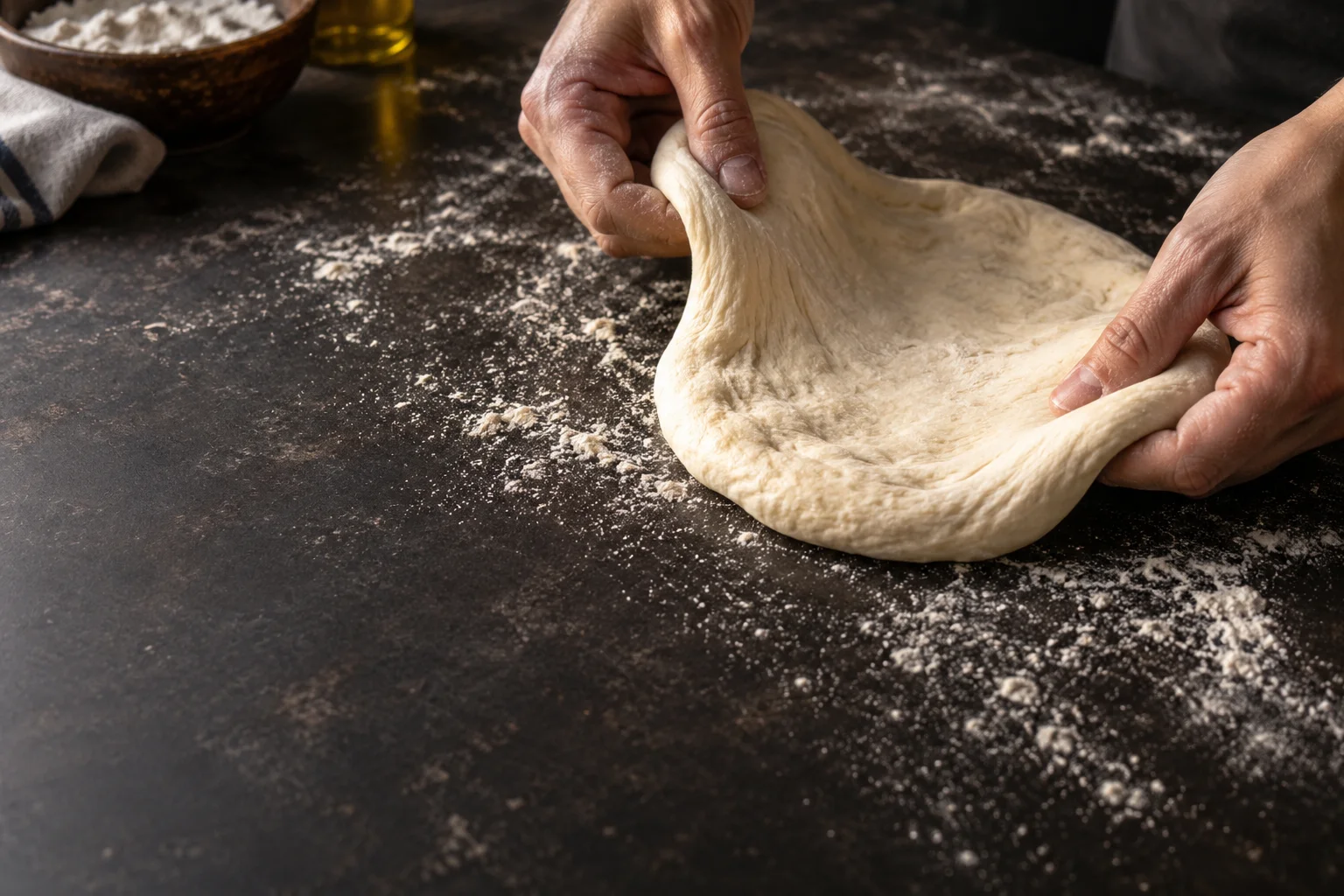
You press a dough ball into a round, stretch it toward the size you want, and watch it pull itself back into a smaller disk. Try again and it does the same thing. That behavior is commonly called snap-back, and it is one of the clearest examples of the balance between elasticity and extensibility.
Elasticity and extensibility are not the same thing
Elasticity is the dough’s tendency to return toward its original shape after it has been stretched. Extensibility is its ability to stretch farther without tearing or immediately shrinking back. Good pizza dough needs both.
A dough with no strength may spread easily but struggle to hold gas, support toppings, or retain its shape. A dough with plenty of strength but too little extensibility fights the baker. Snap-back usually means the balance has shifted too far toward elasticity.
Do not treat “strong dough” as automatically better dough. Strength is useful only when it is balanced with enough extensibility for the pizza style and forming method.
The most common cause: the dough needs more rest
Stretching aligns and tensions the gluten network. Given time, that tension relaxes. This is why a dough round that resists you now may open easily 20 minutes later.
Cover the dough so its surface does not dry out, then leave it alone for 15 to 30 minutes. When you return, press and stretch it gently. If the dough opens with much less resistance, lack of rest was probably the immediate cause.
This can happen even when the dough had a long fermentation. Dividing, balling, degassing, or an aggressive first attempt at opening can all tighten the network again.
Cold dough feels tighter
Dough taken directly from the refrigerator is commonly harder to stretch. Low temperature makes the dough feel firmer and slows the molecular movement that helps the gluten network relax.
The surface can feel ready while the center of the dough ball is still cold. Time at room temperature depends on dough-ball size, refrigerator temperature, room temperature, dough formula, and container arrangement, so the clock alone is an imperfect guide. Handle the dough and observe how it responds.
If the ball still feels dense and cool through the center, give it more covered tempering time. Do not try to solve cold, resistant dough by pulling harder. That often creates a thin center, thick rim, or tears before it solves the underlying problem.
Flour strength can be higher than the process needs
Higher-protein flour can build a stronger gluten network, but flour choice should match fermentation time, dough hydration, mixing, and intended pizza style. A very strong flour used in a short process may produce more resistance than you want.
This does not mean strong flour is wrong. It means the formula and process must give that flour enough water, fermentation, and relaxation to become workable. If snap-back is chronic rather than occasional, compare the flour’s protein level and strength with the demands of your actual process.
Mixing develops strength, but too much can tighten the dough
Mixing hydrates ingredients, distributes yeast and salt, and develops gluten. As development increases, the dough usually gains strength and elasticity. If mixing is too intensive for the formula and process, the dough may emerge tight and resistant.
Before cutting mix time, confirm the dough is actually overdeveloped. Poorly hydrated or undermixed dough can also behave badly, but it often tears, looks rough, or lacks coherent strength rather than showing clean, persistent snap-back. Record actual mix time, mixer speed, and final dough temperature so the next batch gives you evidence instead of another guess.
Fermentation changes handling
Fermentation is not only about flavor and gas production. Over time, biochemical activity changes the dough structure and generally increases extensibility. A young dough may feel tight because it has not had enough time to mature.
At the other extreme, a severely overfermented dough may become slack, sticky, fragile, and difficult to handle for a different reason. Snap-back by itself more often points toward a dough that is young, cold, recently worked, highly developed, or built with more flour strength than its process is using.
Salt, hydration, and dough condition matter too
Salt strengthens and organizes the gluten network while also controlling fermentation. An accidental salt overage can make dough noticeably tighter. Lower hydration can also reduce mobility and make a dough feel less extensible, especially when paired with strong flour or short fermentation.
A dry skin creates another kind of resistance. If dough balls are left uncovered, the surface can form a skin that limits stretching and may tear. Keep dough covered during bench rest and tempering.
Chef Ray’s Green Light Lab test
Test rest time before changing your formula
Use three dough balls from the same batch. Keep every variable the same except the covered bench-rest time.
Stretch each ball with the same technique and compare the diameter immediately after opening and again two minutes later. Record resistance, shrinkage, tearing, and final shape. If added rest solves the problem, you have learned something useful without changing the formula.
A practical troubleshooting order
- Stop forcing it. Cover the dough and let it rest.
- Check temperature. Confirm the center is not still cold.
- Review handling. Avoid aggressive degassing and repeated reworking.
- Check the record. Compare flour, hydration, salt, mix time, final dough temperature, and fermentation against a successful batch.
- Change one variable. Make the smallest controlled adjustment likely to answer the question.
The lesson behind snap-back
Dough behavior is information. Snap-back tells you that the dough has more elastic recovery than its present level of extensibility can balance. Sometimes the fix is as simple as a covered rest. Other times it reveals a mismatch among flour, hydration, mixing, temperature, and fermentation.
The useful question is not only, “How do I make it stop?” It is, “Which variable created this behavior, and what is the smallest test that will prove it?” That is how a frustrating batch becomes a better process.

About the author
Ray Sierengowski
Ray is a food scientist, chef, product developer, author, and founder of Fire in the Kitchen, LLC. He brings more than 30 years of experience in food development, manufacturing, commercialization, and culinary innovation.
© 2026 Ray Sierengowski and Fire in the Kitchen, LLC. All rights reserved. Brief quotations may be used with clear attribution to Ray Sierengowski and a link to the original article. Full reproduction, republication, adaptation, or commercial use requires prior written permission.
Request permission to republish →Keep testing with purpose
Understand the variables behind better pizza dough.
Pizza Dough by the Numbers explains the science, and The Green Light Lab™ Pizza Dough Logbook gives you a place to capture what changed.