
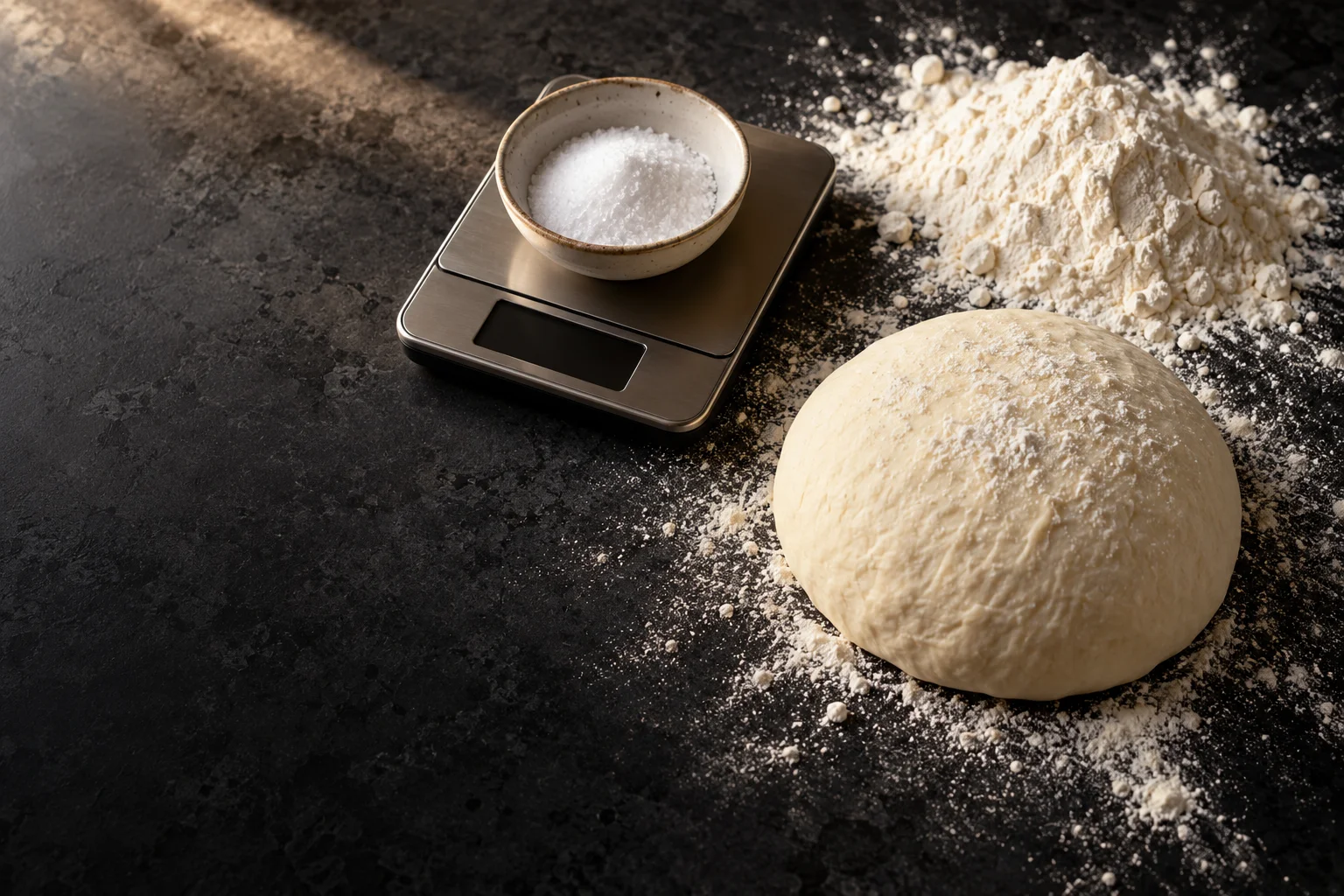
You change the salt in your pizza dough because the last batch tasted a little too salty. On the next bake, the dough seems to ferment differently and feels less familiar in your hands.
That is a useful reminder: salt is part of the dough’s structure and process, as well as its seasoning.
The question “How much salt should I use?” deserves more than a single percentage copied from another recipe. Start with a defined amount, understand its function, and evaluate what changes in your own dough.
How much salt goes in pizza dough?
For a straightforward comparison trial, use 2% of total flour weight as a baseline. Treat that as a starting point for testing, not a universal optimum for every pizza style. King Arthur Baking’s professional reference places typical bread-dough salt at 1.8–2%; pizza formulas and preferences vary. [1]
Baker’s percentages use flour weight as the reference. Salt percentage is therefore:
Salt weight ÷ total flour weight × 100
For 1,000 grams of total flour:
| Salt percentage | Salt weight |
|---|---|
| 1.5% | 15 g |
| 2.0% | 20 g |
| 2.5% | 25 g |
These are comparison levels, not three recommendations. Include flour from a poolish or starter in the total. If the final mix contains 800 grams of flour and the poolish contributes 200 grams, the reference is 1,000 grams. [2]
Salt changes more than flavor
Fermentation
Salt places osmotic stress on yeast and can slow its activity. That is why reducing salt can change fermentation behavior even when the yeast amount stays the same. Normal salted dough still ferments; “salt slows yeast” does not mean “salt prevents dough from rising.” [3]
Dough strength
Research on wheat dough confirms that sodium chloride affects gluten-network strength, gas retention, and yeast activity. The practical response depends on the flour and formulation, so a result from one dough should not become a guaranteed prediction for every pizza recipe. [4]
In troubleshooting, that makes the salt weigh-out worth checking. A change in handling does not automatically mean someone added too much water.
Finished-pizza flavor
Evaluate seasoning in the finished pizza, not only in an isolated piece of crust. Sauce, cheese, cured meat, and finishing ingredients are part of what the customer tastes.
A useful tasting trial should include both a plain baked sample and the intended topped pizza. That helps separate your opinion of the crust from your opinion of the complete product.
Why switching salt brands can change a recipe
A teaspoon of one salt is not necessarily the same mass as a teaspoon of another. Crystal size and shape affect how much fits in the spoon. King Arthur specifically notes that switching between table salt and kosher salt can require measurement changes. [5]
Write the formula in grams. Record which salt you used. If you change the brand or type, preserve the intended weight and check that your mixing method distributes it consistently.
Weighing removes a major source of uncertainty before you start diagnosing fermentation or flour performance.
A Green Light Lab salt experiment
This is a proposed test, not a report of completed results.
Make three small batches with 500 grams of total flour each. Use 7.5, 10, and 12.5 grams of salt to compare 1.5%, 2%, and 2.5%. Use a scale capable of measuring these amounts appropriately.
Keep the flour blend, hydration, yeast percentage, mixing sequence, containers, and planned fermentation conditions consistent. Record final dough temperature rather than assuming all batches leave the mixer equally warm.
Photograph the doughs at the same elapsed times in identical containers. Record visible expansion, spreading, stickiness, opening resistance, and launch behavior. Portion equal-weight balls, open them to the same diameter, and use matching topping weights and baking conditions.
Here is the important experimental distinction: equal time does not guarantee equal maturity. If the doughs progress differently, that is part of the result. Do not label one salt level “better” solely because its dough happened to be closer to readiness at your scheduled bake time.
First ask: “What happens if I change salt and keep my schedule?” In a separate round, ask: “What schedule works best for this salt level?”
Keep those questions separate. Otherwise, you may change salt, yeast, temperature, and time together and lose track of what improved the pizza.
What changes at production scale?
At 25 kilograms of flour, 2% salt means 500 grams. Increasing to 2.5% means 625 grams: a 125-gram difference.
That is why production formulas should specify both the baker’s percentage and the actual batch weight. Include an ingredient check before mixing and record deviations when they happen.
For a consulting or product-development project, define success before reformulating. Are you addressing seasoning, consistency, handling, or a specific sodium target? Those objectives require different evaluations. Changing an ingredient is easy; proving that the revised process meets the objective takes disciplined testing.
Three takeaways
- Salt is a process ingredient. Its effect reaches beyond taste.
- Measure against total flour weight. Include flour from preferments and weigh the salt.
- Test one formulation change at a time. Record the schedule and the actual dough behavior.
That is the approach behind Pizza Dough by the Numbers and The Green Light Lab Pizza Dough Logbook: understand the variables, record the evidence, and make the next adjustment for a reason.
For help developing or troubleshooting a dough formula for your operation, contact ray@fireinthekitchen.com through Fire In The Kitchen.
© 2026 Ray Sierengowski / Fire In The Kitchen, LLC. All rights reserved. For republication permission, contact ray@fireinthekitchen.com.
Sources

About the author
Ray Sierengowski
Ray is a food scientist, chef, product developer, author, and founder of Fire in the Kitchen, LLC. He brings more than 30 years of experience in food development, manufacturing, commercialization, and culinary innovation.